
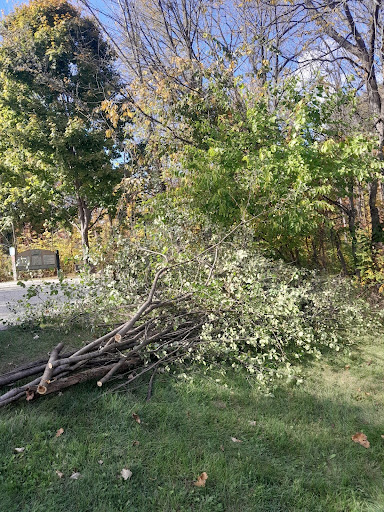
Chopping down trees and removing plants from our local parks may not seem like an environmentally friendly activity, but the BCHS Environmental Club put their saws and loppers to use at the kickoff for this year’s Brookfield Invasive Species Task Force (Brookfield ISTF).
Founded during the 2024-25 school year, the Brookfield ISTF works with the Brookfield Parks and Rec Department and the Department of Natural resources to identify, remove and treat invasive species in the parks of Brookfield. This task group formed after members of the BCHS Environmental Club volunteered with the Elm Grove ISTF, and saw the work that community members were doing to transform their public spaces back into native ecosystems.
The majority of ISTF’s work has been focused on removing the invasive tree known as buckthorn. There are two varieties of Buckthorn commonly found in Brookfield: Glossy Buckthorn (Rhamnus frangula) and Common Buckthorn (Rhamnus cathartica L). These fast growing trees spread by producing massive amounts of berries which drop in the fall and are consumed by birds, who spread them even further. Buckthorn leaves are the first to bud in the spring and the last to drop in the fall, which gives them a leg up over the native tree they grow near. Paired with their intense berry production, buckthorn is able to outcompete all other trees and create a swath of forest that contains only one plant, known as a monoculture.
The best time to remove these trees is in the fall, before the tree has produced berries and the sap is flowing into the roots to store energy for the winter. Cutting down the buckthorn tree now stops it from dropping thousands of berries and ensures that the sap will draw down any herbicides that are directly applied to the stump, killing the roots to stop resprouting. Additionally, Common Honeysuckle (Lonicera periclymenum), Garlic Mustard (Alliaria petiolata), and Dame’s Rocket (Hesperis matronalis) are also invasive species targeted by the ISTF.
So far, efforts have been focused on Mound Zion Park on North Rd. Teams have been working there for two years, and the impact is taking shape. The area near the parking lot, which was formerly a dense overgrown mixture of buckthorn and honeysuckle is beginning to give way to native saplings and ground cover.
In the future, these areas will be replanted with native trees and maintained to ensure the buckthorn is gone for good. Furthermore, work in the Rolling Meadows area will help restore some of the native marshes Brookfield was built on in addition to removing invasive species.
If you are interested in earning volunteer hours, fighting a tree, or doing something to help the environment, send an email to [email protected] and join the email list for details about where and when ISTF will be meeting.